

Nobody tells you this part.
You spend decades looking forward to retirement. No more alarm clocks, no more meetings, no more answering to anyone. And then it finally happens — and somewhere around week three, you’re sitting in your kitchen wondering why you feel… off. Maybe even a little lost.
If that’s you, you are not broken, and you are not alone. What you’re feeling has a name, even if nobody warned you about it: it’s a real adjustment, not a personal failing. For years, your job (or your kids’ schedules, or both) gave you a reason to get up, people to talk to, and a sense that you mattered to someone’s day. When that disappears all at once, it’s normal to feel a little untethered. Losing that daily structure can hit just as hard as any other big life change — even a happy one.
Here’s the good news: this feeling isn’t permanent, and you don’t need to “fix” your whole life to feel better. You just need a few things back — a reason to get dressed, people to see, something to look forward to. That’s really all a good hobby is.
Below are 7 hobbies that do more than pass the time. They rebuild the stuff retirement quietly takes away: purpose, connection, and a little bit of “this is my life now, and I like it.”
1. Volunteering for a Cause You Care About
If you only try one thing on this list, let it be this one.
Study after study on retirement happiness points to the same thing: the people who feel best aren’t the ones lounging the most — they’re the ones who still feel needed. Volunteering gives you that, almost instantly. You show up, you help, and someone is genuinely glad you were there. That feeling is hard to get anywhere else once you’ve left a job.
And the best part is you get to pick what matters to you. Maybe you loved being a nurse, so you volunteer at a hospital gift shop or help out at a health clinic. Maybe you always wished you had more time to read — so you read to kids at your local library. Loved mentoring younger coworkers? A lot of organizations are looking for women exactly like you to mentor young adults just starting out.
You don’t need to commit to five days a week either. Even three or four hours, once a week, is enough to give your calendar a heartbeat again.
How to actually start this week:
- Go to VolunteerMatch.org and type in your zip code — it’ll show you real openings near you, sorted by what you’re interested in.
- Call your local Area Agency on Aging (every county has one) and ask what volunteer programs they run or know about.
- Ask at your church, synagogue, or community center — most have a list of local needs taped to a bulletin board somewhere.
Pick one. Send one email or make one call this week. That’s the whole first step.
2. Joining a Walking or Hiking Group

Here’s a sneaky little problem with retirement: your body doesn’t move as much as it used to, even if you don’t notice it happening. No more walking to meetings, no more running errands on your lunch break, no more chasing after a schedule all day. And on top of that, it’s easy to go a whole day without really talking to anyone.
A walking group fixes both of these at the same time, without it feeling like “exercise” or “making friends” — it just feels like a nice morning.
You don’t need to be in great shape to start. Most groups walk at a comfortable pace and chat the whole way, which is honestly the point. You show up, you move your body, you talk to people, and an hour later you feel better than you have in days. It’s one of those things that sounds too simple to work — but it really does.
If walking on trails feels like too much too soon, that’s fine. A lot of women start with mall walking (yes, really — it’s a whole thing, and it’s wonderful: flat ground, air conditioning, and a coffee shop at the end).
How to actually start this week:
- Search Meetup.com for “walking group” or “hiking group” plus your city — you’ll likely find several, at all fitness levels.
- Check the bulletin board at your local senior center — walking groups almost always meet there or post there.
- Search Facebook for your town’s name plus “walking club” — many are run informally and welcome new faces every week.
You don’t have to hike a mountain. You just have to walk out your front door with somewhere to be.
Read Also: Retired and Lost Your Rhythm? Here is How to Structure Your Day in Retirement in 5 Easy Steps
3. Learning to Paint or Draw

There’s something about painting that surprises a lot of people who try it later in life: it’s not about being “good” at it. It’s about having something that’s just yours.
For a lot of women, especially after a career or years of taking care of everyone else, so much of your day used to be about other people — your job, your family, your to-do list. Painting flips that. Nobody’s grading it, nobody needs it by Friday. It’s just you, some color, and a blank page, slowly turning into something.
And there’s a real, satisfying feeling in having something to show for your time. At the end of an afternoon, you have an actual painting sitting there — proof that you did something, made something, learned something new. That feeling matters more than people expect.
You also don’t need any experience. Truly none. Watercolor is a great place to start because it’s forgiving and doesn’t require a lot of expensive supplies. Acrylic pouring is even more beginner-friendly — you basically pour paint and tilt the canvas, and it always turns out interesting. If you’d rather start smaller, simple pencil sketching only needs paper and a pencil you probably already have in a drawer.
How to actually start this week:
- Look up your local community college’s continuing education catalog — most offer casual, no-pressure art classes just for adults, no degree involved.
- Search for a local art studio near you — many offer “paint and sip” nights or beginner classes with all supplies included.
- Type “watercolor for beginners” into YouTube if you’d rather try it at home first, with zero pressure and zero cost.
You’re not trying to become an artist. You’re just giving yourself something that’s quietly, completely yours again.
4. Taking a Class Through a Lifelong Learning Program
Miss having somewhere to be on Tuesday mornings? This one’s for you.
A lot of women miss the rhythm of work more than the work itself — having a set day and time, a reason to plan your week around, a place you’re expected to show up. A class gives you all of that back, minus the boss and the deadlines.
The topics are usually the fun kind of learning, too — not tests, not homework, just genuinely interesting stuff. Think classes on World War II history, Jane Austen novels, current events discussions, or finally learning the Spanish you always meant to learn before that trip to Mexico. You’re there because you want to be, sitting in a room full of people who also want to be there. That changes everything about how it feels.
The best-kept secret here is something called OLLI — Osher Lifelong Learning Institutes. They’re run through universities all over the country, built specifically for adults 50 and up, and they’re usually very affordable. No tests, no grades, no pressure — just good discussion and interesting people.
How to actually start this week:
- Search “OLLI” plus your state or nearby university — there’s very likely one within driving distance.
- Ask if they offer a free trial class or open house before you commit to a full term.
- Pick a topic you’re genuinely curious about, not one you think you “should” take. This isn’t school anymore — enjoy that.
Tuesday mornings are yours to fill however you want now. This is a really good way to fill them.
5. Writing Your Memoir or Family Stories

You’ve lived a whole, full life. You have stories nobody else has — funny ones, hard ones, ones your grandkids have probably never heard. Writing them down does two things at once: it gives you something meaningful to work on, and it becomes a real gift to the people you love.
There’s also something quietly healing about putting your life on paper, especially right now. Retirement has a way of making you look back and think about everything that led you here — the choices, the people, the turns you didn’t expect. Writing it down helps you make sense of it, instead of just carrying it around in your head.
And you don’t need to write “a book.” Even a few pages of memories, or letters written to your grandchildren about your childhood, count. Some women simply keep a journal of stories as they remember them, in no particular order. There’s no wrong way to do this.
How to actually start this week:
- Check if your local library offers a memoir-writing workshop — many run free ones specifically for older adults, with a small, friendly group.
- Try StoryWorth — it sends you one simple question a week (like “What was your wedding day like?”), and turns your answers into a printed book at the end of the year. Family members can even ask you the questions.
- Or skip all of that and just start with a notebook and one sentence: “One thing I want my grandkids to know about me is…”
You don’t have to be a writer. You just have to remember. The rest takes care of itself.
Read Also: 10 Small Things To Do To Find Joy In Life Again During Retirement
6. Gardening
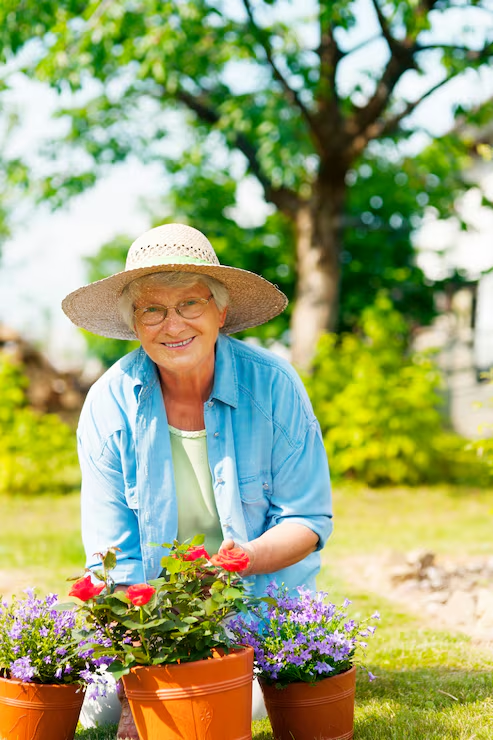
There’s a reason gardening has been keeping people happy for basically all of human history — it just works.
Think about what a garden actually gives you: a reason to go outside every single day, something that needs you (even if it’s just a tomato plant), and real, visible proof that your care made something grow. That last part matters more than people realize. In a season of life where it can feel like nothing you do has a clear result, watching a seed turn into a flower — because of you — feels really, really good.
It’s also just calm. No deadlines, no one grading your garden, no pressure. Some days you’ll spend twenty minutes pulling weeds and feel better than you have all week. That’s a pretty good trade.
You don’t need a big yard, or even a yard at all. A few pots on a balcony count. Tomatoes, herbs, or flowers in containers are an easy, forgiving place to start. If you have more space, a lot of towns have community garden plots you can rent for the season — which comes with a nice bonus: other gardeners to talk to while you’re out there. And if you like the idea of helping the planet a little while you’re at it, a native plant or pollinator garden (the kind that attracts butterflies and bees) is an easy, rewarding option.
How to actually start this week:
- Look up your local extension office — nearly every county has one, and many run Master Gardener programs that are free or very cheap and welcome total beginners.
- Search “community garden” plus your city to see if there’s a plot near you — popular ones do have waitlists, so it’s worth checking now.
- Or just buy one pot, one bag of soil, and one plant this weekend. That’s a real garden. It counts.
7. Pickleball or a Social Sport

If you haven’t heard of pickleball yet, you’re about to — it’s the fastest-growing sport for older adults in the entire country right now, and once you understand why, it makes total sense.
It’s like tennis, but smaller, slower, and way easier to pick up. The court is smaller, the ball is lighter, and you’re not expected to be athletic to have a great time. Most importantly, it’s incredibly social — you play in pairs, you chat between points, and most towns now have groups that meet several times a week specifically for beginners. You could show up knowing zero people and leave with plans for lunch.
If pickleball isn’t your thing, that’s okay — the goal here is really just “something social that gets you moving.” Water aerobics is easy on the joints and usually has a fun, chatty group. Line dancing doesn’t need a partner, it’s more forgiving than it looks, and it’s honestly a great workout disguised as fun. Pick whichever one sounds the least intimidating and just try it once.
How to actually start this week:
- Call your local parks and recreation department — nearly all of them run beginner pickleball, water aerobics, or dance classes, usually for a small fee.
- Check your local YMCA — most have all three of these, plus childcare-style flexibility if grandkids are ever in tow.
- Use Places2Play (USA Pickleball’s official finder tool) to find courts and beginner groups near you — just type in your zip code.
You don’t need a partner, equipment, or experience to start. You just need to show up once. The people there will take care of the rest.
Read Also: 7 Common Money Mistakes That Are Hurting Your Retirement Savings
You Don’t Need a Whole New Life. Just a Next Step.
Here’s the truth: you don’t need to reinvent yourself to feel like yourself again. You just need a little bit of routine, a few people to talk to, and something that’s genuinely yours. That’s really it. That’s the whole secret.
So don’t put pressure on yourself to pick “the right one” from this list. Just pick one that sounds even a little bit interesting, and try it. If it’s not for you, that’s fine — try another one. Most women who feel settled in retirement didn’t get there by planning it perfectly. They got there by trying a few things and paying attention to what made them feel like themselves again.
The bad days won’t disappear overnight. But a Tuesday with somewhere to be, and people who are glad you showed up? That adds up to something real.
We’d love to hear from you: which one of these are you going to try first? Or if you’ve already found something that brought you back to life, tell us about it in the comments below — your story might be exactly what another woman reading this needs to hear today.