
Do you know how much credit card debt the average American is carrying right now? As of mid-2026, it’s about $6,610 per person — and if you look at a typical household instead of just one person, that number jumps to over $9,300. On top of that, if you carry a balance, you’re paying an interest rate close to 22%, which means that debt isn’t just stressful, it’s expensive to hang onto.
Here’s the thing: none of this would have made much sense to your grandparents. Back in the 1950s, most people didn’t have a credit card sitting in their wallet. If you didn’t have the cash for something, you simply didn’t buy it. That was the whole rule.
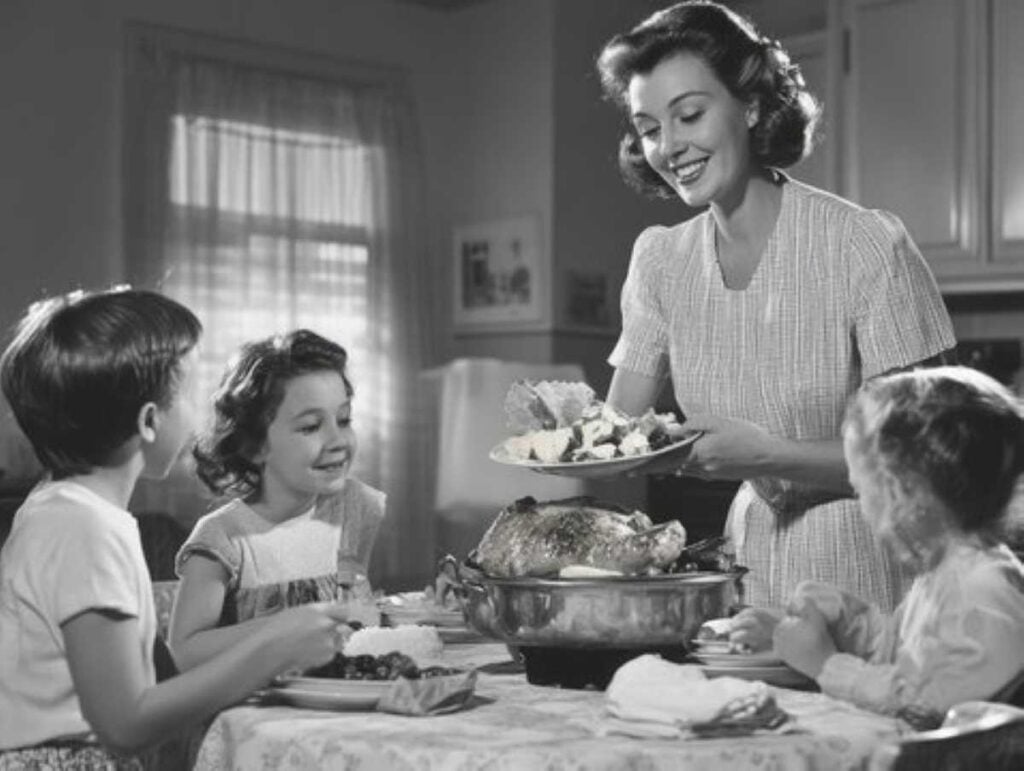
It wasn’t because life was easier back then, either. A lot of families were still catching their breath after the Great Depression and World War II, and money was often tight — especially on one income. So people got really, really good at stretching a dollar. They didn’t have a choice.
And here’s the surprising part: those old habits line up almost perfectly with the problems we’re dealing with today. Too much debt. Too much stuff. Too much waste. The tricks people used just to get by in the 1950s still work now — they just need a small update for this decade.
Let’s go through seven of them.
1. Cash Envelope Budgeting
Here’s how it worked: when payday came, a lot of 1950s families would cash the paycheck and divide it up into envelopes right at the kitchen table. One envelope for rent. One for groceries. One for the electric bill. Maybe one for “fun money,” if there was any left.
Once an envelope was empty, that was it. No groceries envelope left? You made do with what was already in the pantry until next payday. Nobody was swiping a card to cover the gap, because credit cards for everyday people barely existed yet. Cash was the only thing standing between people and overspending, so they built a whole system around it.
Why does this matter now? Because today, we’ve got the opposite problem. Spending money has never been easier. Tap your phone, click “buy now,” use one of those apps that splits a purchase into four payments — and suddenly you’ve spent way more than you meant to, without ever really feeling it happen. That’s a big piece of why the average person is carrying over $6,600 in credit card debt, with interest rates that make it even harder to dig out.
The envelope trick works because it makes spending feel real again. When money is just a number on a screen, it’s easy to lose track of. When it’s actual bills sitting in an envelope, you can watch it disappear — and that makes you think twice before you spend it.
You don’t have to go full 1950s and start hiding cash in envelopes around the house (though plenty of people do — it’s called “cash stuffing,” and it’s huge on TikTok right now, especially with people in their 20s trying to get a handle on their spending). You could also use a budgeting app like YNAB or Goodbudget, which basically turns the envelope trick digital: the moment money hits your account, you give every dollar a job, so it can’t quietly vanish on stuff you didn’t plan for.
Either way, it’s the same idea your great-grandparents used: decide where the money’s going before you spend it, not after.
2. “Planned-Overs” and From-Scratch Cooking
In the 1950s, most moms didn’t decide what was for dinner an hour before dinner. They planned the whole week’s meals ahead of time, usually built around whatever was on sale that week at the grocery store. And they didn’t just cook dinner for one night — they cooked with the next night in mind too. Sunday’s roast beef became Monday’s beef hash. Leftover mashed potatoes turned into potato pancakes. Nothing sat in the fridge going bad, because there was already a plan for it.
This wasn’t some clever life hack. It was just what you had to do when the grocery budget was tight and wasting food meant wasting money you didn’t have extra of.
Here’s why that matters today, maybe even more: the average American household wastes almost a third of the food it buys, worth an estimated $1,866 a year. That’s real money going straight into the trash. On top of that, a lot of us spend way more eating out or ordering delivery than we would cooking the same meal at home, once you add on delivery fees, service fees, and a tip.
The fix isn’t complicated, and it’s basically the same one your grandparents used: plan ahead so food doesn’t go to waste, and cook once for two or three meals instead of starting from zero every night.
You can update the “planned-overs” trick pretty easily. Batch cooking is the modern version — cook a big pot of chili or a tray of roasted chicken on Sunday, and you’ve got lunches and dinners covered for half the week.
Some people do what’s basically “ingredient math”: buy chicken, rice, and a bag of frozen veggies, then turn that same base into three totally different meals just by changing the sauce or seasoning. And instead of a paper grocery flyer, you can check store apps or sites like Flipp to see what’s on sale before you make your list — same idea as your grandma circling coupons at the kitchen table, just on a phone instead of a newspaper.
Read Also: 14 Ways to Cut Your Grocery Bill in Half (And Save Hundreds Every Month)
3. “Make Do and Mend”
Back in the 1950s, if your sock got a hole in it, you didn’t throw it away — you got out a needle and thread and darned it. Torn jeans got patched. Worn-out shoes went to the shoe repair shop to get resoled instead of tossed in the trash. This habit actually started a bit earlier, during WWII, when the government told people to “make do and mend” because materials were needed for the war. By the 1950s, it had just become a normal part of taking care of your stuff.
It worked because things were built to be fixed back then. Clothes had sturdier stitching, shoes had soles you could replace, and people expected to keep an item for years, not months.
Now compare that to today. Clothes are often cheaper to buy new than to fix, and that’s a real problem. Each year, Americans throw away roughly 12.8 million tons of textiles, or about 80 pounds of clothing per person. Multiply that across the whole country, and clothing has become one of the biggest things clogging up our landfills. A lot of that is stuff that got worn a handful of times, then tossed, because buying something new felt easier than fixing what was already in the closet.
The good news is this one’s making a comeback. You don’t need to be great with a needle to bring “make do and mend” into your life. A basic mending kit — needle, thread, a few buttons, some iron-on patches — fixes most small rips or missing buttons in about ten minutes. “Visible mending” has even become a style trend of its own: instead of hiding a patch, people sew it on with bright, contrasting thread on purpose, so the repair becomes part of the look. A lot of cities now have repair cafés too, where volunteers help you fix torn clothes, broken toasters, or wobbly furniture for free.
Here’s a simple way to think about it your 1950s grandparent would’ve understood right away: cost-per-wear. A $60 jacket you wear 100 times costs you 60 cents a wear. A $15 shirt you wear twice and toss costs you $7.50 a wear. Buying less, but buying things worth repairing, wins in the long run almost every time.
4. The Strict Written Shopping List
Before heading to the grocery store in the 1950s, you wrote a list. Not a rough idea of what you might need — an actual list, usually made at the kitchen table, based on the meals planned for the week. And once you got to the store, you stuck to it. You didn’t wander down every aisle “just to look.” You got what was on the list and left.
This wasn’t some kind of superhuman willpower. It was just how shopping worked. There were no algorithms quietly suggesting extra stuff, no phone in your pocket pinging you with a flash sale. The list was the whole plan, so people followed it.
Staying on budget today is a much harder fight, and it’s honestly not your fault. Stores and shopping apps are built, on purpose, to get you to buy more than you planned. Online, it’s even easier to slip — one click and it’s bought, no walk to the register, no moment to reconsider. It adds up fast: on average, Americans spend around $450 a month on stuff they never planned to buy, which comes out to over $5,000 a year.
That’s not because people today have worse self-control than people in the 1950s. It’s because the entire shopping experience — especially online — is designed to make you spend more, while the tools that used to fight back against that, like a plain written list, mostly disappeared.
Bringing this one back is genuinely simple. Write a real list — on your phone’s notes app or a list app — before you shop, and only buy what’s on it. For online shopping, try the “24-hour rule”: when you want to buy something that isn’t a need, add it to your cart and wait a full day before checking out. A lot of the time, that urge fades once the excitement wears off. It also helps to unsubscribe from retailer emails and texts — those “sale ends tonight!” messages exist for one reason, and it’s not to help you save money.
5. The Backyard Victory Garden
During World War II, the government asked American families to plant “Victory Gardens” in their backyards, so more food grown on farms could go feed soldiers overseas. Millions of people did it. By 1943, somewhere between 18 and 20 million of these gardens were producing about 40% of the fresh vegetables eaten in the whole country. When the war ended, a lot of families just kept gardening. It had become a normal part of life, and it kept grocery bills down at a time when money was tight.
It worked for a simple reason: growing your own tomatoes or beans costs way less than buying them once a garden’s up and running. A couple of dollars on a packet of seeds can produce a lot more food than that same money buys at the store.
This habit is making a real comeback right now, for a similar reason. Fresh vegetable prices have jumped about 10% over the past year, with tomatoes and lettuce climbing even more than that. It’s no surprise that a large majority of people say they’re planning some kind of backyard garden project this year, and most point to rising grocery prices as the main reason why.
The good news is you don’t need a big backyard, or any backyard, to get in on this. If you’ve got a yard, even a small raised bed with a few tomato plants and some herbs can make a real dent in your grocery bill. Renting or in an apartment? Container gardening works great on a balcony or patio — tomatoes, peppers, and herbs all do fine in pots. No outdoor space at all? A few pots of basil, mint, or green onions on a sunny windowsill still saves you from buying fresh herbs that wilt in your fridge after two uses.
And if none of that fits your space, a lot of cities have community garden plots you can rent cheap, where you get a real patch of dirt to grow in, plus neighbors happy to tell you what’s working in theirs.
6. Line-Drying and Energy Frugality
In the 1950s, most laundry didn’t go anywhere near a dryer — it went on a clothesline in the backyard, or on a rack strung up in the kitchen when it rained. Electric dryers existed, but not every home had one yet, and they weren’t cheap to run. So line-drying wasn’t some eco-friendly lifestyle choice. It was just how you dried your clothes.
Families were careful with electricity in general, not just laundry. You turned off lights when you left a room. You didn’t run the oven and the iron at the same time if you could help it. And when a cold draft crept in under a door or around a window frame, nobody called anyone — you grabbed a rolled-up towel and stuffed it in the gap yourself. None of this was fancy. It was just treating electricity like the real expense it was, because a family living on one income couldn’t afford to waste it.
That mindset is worth borrowing back, because energy costs have gone seriously in the wrong direction. Residential electricity prices have jumped by almost 40% since 2021, rising much faster than prices in general. And the dryer is a real part of why laundry costs add up: on average, running a dryer adds about $83 a year to the electric bill, and dryers alone can push up a typical home’s electricity bill by around 6%.
You don’t need a full backyard clothesline to bring this one back, though if you’ve got the space, it works great and costs nothing. An indoor drying rack does almost the same job — hang a load up after your last wash of the day, and it’s usually dry by morning.
Running big appliances like the dishwasher or washing machine later at night, when a lot of utility companies charge less, can shave a little off your bill too. And weatherproofing your home doesn’t have to mean a big renovation — a cheap roll of weatherstripping around a drafty door or window can pay for itself in a single winter.
Read Also: 15 Frugal Habits That Save Me a Fortune Without Making Me Look Cheap
7. Neighborly Bartering and Skill-Sharing
In a lot of 1950s neighborhoods, you didn’t pay for everything with money. If your neighbor kept chickens, you might trade a dozen eggs for an afternoon of babysitting. Need a ladder or a power drill for one job? You borrowed your neighbor’s instead of buying your own. Someone down the street was good at fixing cars, someone else was good at sewing, and people just traded those skills back and forth instead of hiring a stranger and paying full price.
This worked because neighborhoods back then were genuinely close, and a lot of households were running on one income, so leaning on each other wasn’t optional — it was how things got done. Everybody needed something from someone else eventually, so people stayed connected on purpose.
Today, we’ve basically replaced all of that with apps. Need a ride? There’s an app for that. Need groceries brought to your door? Someone else will do it, for a price. Need a night of babysitting? Book it through an app. It’s incredibly convenient, but it also means we’ve quietly stopped relying on each other, and it’s not cheap: the average American now spends nearly $1,850 a year on food delivery alone, and more than a third of that is just fees and tips, not even the food. On top of the money, there’s a bigger cost, too. About a third of U.S. adults say they feel lonely on a regular basis, and a lot of that comes down to exactly this kind of disconnection from the people around us.
The good news is this old habit is making a comeback, in a modern form, and it doesn’t require becoming best friends with your whole block overnight.
Tool libraries let you borrow a drill, ladder, or pressure washer for free or cheap instead of buying one you’ll use twice a year.
“Buy Nothing” groups, usually run on Facebook by neighborhood, are basically a digital version of trading over the backyard fence — people give away or swap stuff they don’t need, no money involved.
Some neighborhoods have skill-trading circles, where you might teach someone guitar in exchange for help fixing your bike.
None of it takes much, just a willingness to ask and to offer something back. That was the whole system in the 1950s, and it still works today.
Final Thoughts
Here’s the big thing to remember: none of these habits were about being cheap for the sake of being cheap. They weren’t a punishment, and they weren’t about doing without. They were just a smart system for handling money when things were tight — and it turns out a good system doesn’t expire. It still works, decades later, even though the world looks completely different now.
That’s really the whole point of this list. The 1950s didn’t have credit cards, food delivery apps, or fast fashion, so families built habits that worked around those gaps. We have all of that now, and it’s part of why money slips through our fingers so easily. Bringing a few of these old habits back isn’t about turning your life into a museum exhibit. It’s about borrowing a system that already worked, and just updating it for today.
You don’t need to try all seven of these at once. Honestly, please don’t — that’s a fast way to burn out and quit after a week. Pick one or two that actually fit your life right now. Maybe it’s writing an actual shopping list before you hit the store. Maybe it’s cooking one big meal on Sunday so you’re not tempted to order delivery on a tired Tuesday night. Small changes like that add up a lot faster than people expect.
And remember that number from the start: the average American is carrying over $6,600 in credit card debt, with interest rates north of 20% making it worse every month it sits there. That’s not a personal failing — it’s what happens when an entire system is built to make spending easy and saving hard. The families who figured out how to beat that system in the 1950s didn’t have any special willpower. They just had better habits. And now, so can you.