
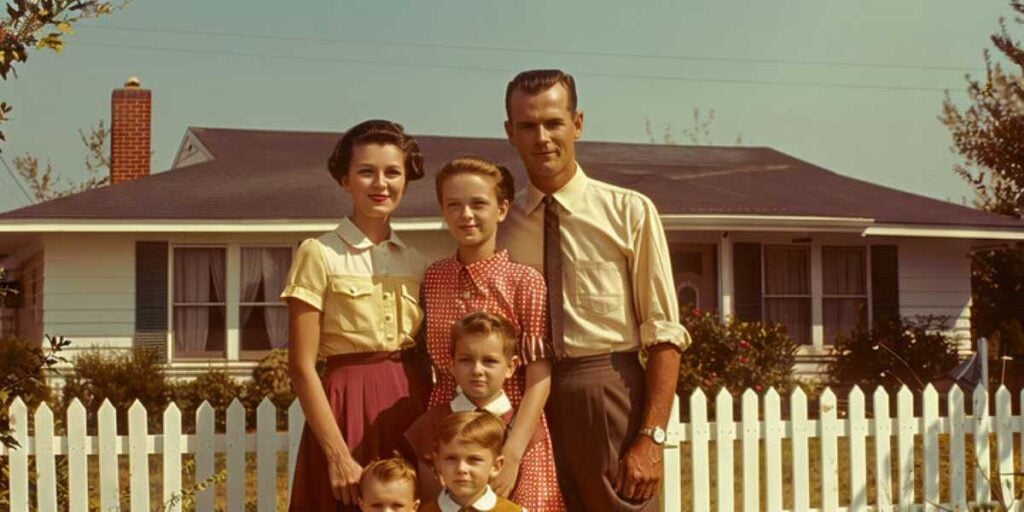
A look back at the everyday habits of postwar American households — from the mundane to the mildly alarming
Close your eyes and picture this: a casserole bubbling in the oven, the hiss of an iron pressing down on a shirt, a little curl of cigarette smoke drifting over the stove while dinner cooks. That was just a normal afternoon in my mom’s kitchen back in the 1950s. Nothing fancy. Nothing that seemed strange at the time. It was just… life.
But looking back now? Some of it seems pretty wild.
Growing up, none of this stood out to me. It was just how things were done. It wasn’t until years later — as an adult, looking back with fresh eyes — that I realized how different (and sometimes kind of surprising) my mom’s everyday habits actually were.
A lot of it made sense for the time. Most households ran on a single income. Families were moving out to the suburbs in droves. Brand-new appliances were showing up in kitchens everywhere, all promising to make life “easier” and more “modern.” And the roles for moms and dads? Pretty much locked in from the start, no real discussion needed.
So here are 12 things my mom did at home that felt completely normal back then — some of it sweet, some of it a little shocking, and all of it a window into what everyday life really looked like in the 1950s.
1. She ironed everything — even the stuff no one would ever see
My mom didn’t just iron her Sunday dress. She ironed sheets. Pillowcases. Dish towels. Even underwear. I remember asking her once why she bothered pressing something nobody but her would ever look at, and she just shrugged like it was the most obvious thing in the world. “Because it should be done right,” she said.
Back then, a smooth, crisp home wasn’t just about looking nice — it was proof you were a good homemaker. Neighbors might peek at your clothesline. Guests might notice a wrinkled tablecloth. So ironing wasn’t a once-in-a-while chore you saved for a big event. It was just… Tuesday. Or Wednesday. Or basically any day that ended in “y.”
Looking back, it’s wild to think about how much time and sweat went into pressing things nobody would ever see. But to her, it wasn’t a big deal. It was just part of running a proper household — one crease at a time.
2. She smoked in the kitchen, in the car, even while pregnant
This one always gets people’s jaws to drop. My mom smoked everywhere. While cooking dinner. While driving us to school. While pregnant with my older brother. And nobody thought twice about it — not her doctor, not her friends, not even the nurses at the hospital.
That’s because back in the 1950s, nobody really knew — or wanted to admit — how bad cigarettes actually were for you. Doctors showed up in cigarette ads. Some even recommended certain brands to “soothe your throat.” Smoking wasn’t seen as a bad habit. It was just a normal part of daily life, like drinking coffee or reading the paper.
So my mom lighting up in the kitchen while stirring a pot of soup wasn’t reckless to her — it was just what everyone did. It’s a strange reminder of how much we know now that people back then simply couldn’t have known.
3. Dinner came out of a can — and that was considered modern
If you opened my mom’s pantry back then, you’d see rows of canned green beans, canned peas, canned soup — you name it. And dinner? A lot of nights it was a casserole made with cream of mushroom soup, some canned veggies, and whatever meat was on sale. Sometimes there was even a wobbly, fruit-filled Jell-O salad sitting on the table like it was dessert and a side dish at the same time.
Here’s the thing — none of this felt lazy or cheap to her. It felt exciting. Canned and packaged food was brand new and modern. It meant you didn’t have to spend all day cooking from scratch like your grandmother did. Companies even ran ads bragging about how “easy” and “science-approved” their food was.
So while a casserole made from three cans and a box might sound a little questionable today, back then it was basically the height of convenience — a sign that things were getting better, faster, and easier.
4. She wore a full face of makeup and a “housedress” just to clean
My mom never just threw on sweats to vacuum the living room. She’d do her hair, put on lipstick, and slip into what was called a “housedress” — basically a nice-looking dress made just for chores. Even if she wasn’t leaving the house or seeing another soul all day, she still got dressed like someone might drop by any minute.
That wasn’t vanity. It was expectation. Women back then were expected to look put-together at all times — even while scrubbing floors or hanging laundry. Magazines and ads reinforced this nonstop, showing smiling women in pearls and aprons, looking flawless while doing housework that clearly should’ve messed up their hair by lunchtime.
Looking back, it’s kind of amazing (and a little exhausting) to think about. Somehow “just cleaning the house” came with its own dress code.
Read Also: Check Your Attic: 14 Antique Household Items Worth a Fortune Today
5. Kids drank from the garden hose and roamed the neighborhood unsupervised
On a hot day, we didn’t ask for a water bottle — we just ran over to the garden hose, took a big gulp, and kept playing. Nobody worried about germs or where that hose had been. And once we were outside, my mom had zero idea where we actually were. We could be three houses down, at the park, or halfway across the neighborhood on our bikes.
There were no cell phones to check in with. No tracking apps. No scheduled pickup times. The only real rule was: come home when the streetlights turn on. That was it. That was the whole system.
Looking back, it’s wild how much freedom kids had — and how little anyone worried about it. Parents weren’t being careless. That’s just how every kid grew up back then. Nobody knew any different, so nobody questioned it.
6. There was a bacon grease can that never left the stove
Right next to the stove, my mom kept an old coffee can — and every time she cooked bacon, she’d pour the leftover grease straight into it. That can never got washed out or thrown away. It just sat there, getting used again and again to fry eggs, potatoes, pretty much anything that hit the pan.
Nobody thought about how much fat or salt was in their food back then, because honestly, nobody was really tracking that stuff. Nutrition labels didn’t even exist yet. There was no “low-fat” or “heart-healthy” anything. Food was just food — you cooked with what tasted good, and bacon grease definitely tasted good.
Looking back, it’s kind of funny (and a little gross) to picture that grease can just sitting there day after day. But to her, it wasn’t wasteful or unhealthy. It was just smart cooking — why throw away good flavor?
7. She mixed her own cleaning chemicals without a second thought
Cleaning day at my mom’s house sometimes meant mixing bleach and ammonia together, right there in a bucket, with the windows shut and no mask in sight. She wasn’t trying to be careless — she just had no idea that combo could actually be dangerous. Nobody warned her. There weren’t safety labels shouting “DO NOT MIX” like there are today.
And it wasn’t just cleaning supplies. Back then, people sprayed pesticides like DDT indoors, in the yard, even around kids playing outside. It was marketed as safe — some ads even showed kids running through the spray like it was no big deal.
We know so much more now about what’s actually safe to breathe in or mix together. But back then, if a product was on a store shelf, people just trusted it. Nobody thought to double-check.
8. No one wore a seatbelt — including the kids in the front seat
Car rides looked a lot different in the 1950s. Kids didn’t sit buckled up in the back seat — they climbed all over the car. Sometimes standing up. Sometimes riding in the very front, right next to Mom, with nothing holding them in place. Seatbelts existed, technically, but almost nobody used them, and plenty of cars didn’t even have them installed yet.
Car seats for babies and little kids? Also barely a thing. If they existed at all, they definitely weren’t the sturdy, strapped-in seats we use today.
It’s hard to imagine now, but back then, nobody really connected “seatbelt” with “safety.” Cars were newer, roads were less crowded, and the rules we take for granted today just hadn’t been invented yet. It wasn’t that parents didn’t care — they simply didn’t know what we know now.
Read Also: 14 Vintage Kitchen Items You Might Already Have at Home That Collectors Are Paying Big Money For
9. Spanking was just “discipline,” not a discussion
If you got out of line back then, there was no long talk about feelings or “let’s use our words.” A spanking was just… what happened. Nobody saw it as harsh or up for debate — it was simply how kids were corrected when they misbehaved. Teachers could do it. Parents definitely did it. And almost nobody questioned whether it was the right approach.
And if your mom said the words “wait till your father gets home” — that wasn’t an empty threat. That was basically a countdown. You spent the rest of the day nervous, watching the clock, dreading the sound of the front door.
Looking back, it’s a big shift from how most people think about discipline today. But at the time, it wasn’t seen as extreme. It was just how parenting worked — quick, physical, and over within a few minutes, no long conversation needed.
10. She did laundry with a wringer washer and hung everything to dry
Doing laundry wasn’t a quick “toss it in and walk away” kind of task. My mom used a wringer washer — a machine where you’d feed wet clothes through two rollers by hand to squeeze the water out before hanging everything on a line outside to dry. It was slow. It was physical. And it definitely wasn’t something you could do while scrolling on your phone, since, well, phones didn’t exist yet.
Laundry usually had its own day — often Monday — because it took that long to get through it all. Wash, wring, hang, wait, fold… repeat for basically the entire day.
It’s easy to take today’s washers and dryers for granted, but back then, “doing the laundry” was basically a full workout. My mom didn’t complain about it, though. It was just Monday’s job, plain and simple.
11. Cocktail hour started before dinner was even on the table
Before dinner even hit the table, it wasn’t unusual for my mom (and dad) to have a drink in hand. Cocktail hour was a real thing — a casual little tradition where adults would pour a drink, relax, and chat before sitting down to eat. If guests came over, drinks were basically part of saying hello.
Nobody thought twice about having a cocktail on a random Tuesday, or serving guests drinks the second they walked in the door. It was just part of being a good host — friendly, normal, expected.
And the norms around drinking and driving? Very different too. People didn’t think as carefully about getting behind the wheel after a drink or two. There wasn’t the same awareness — or the same laws — that we have today.
Looking back, it’s a little jarring how casual it all was. But at the time, it was just… how evenings started.
12. Kids were “seen and not heard” at the dinner table
Dinner time at my house had rules — real ones, not just suggestions. Sit up straight. No elbows on the table. Don’t speak unless someone asks you something. And definitely don’t interrupt the adults, even if you had something important to say. Kids were expected to be polite, quiet, and basically invisible until dinner was over.
There were unspoken rules about the room itself, too. Dad sat at the head of the table — that was just his spot, no question. Mom, meanwhile, was the one hopping up every few minutes to grab something from the kitchen, make sure everyone’s plate was full, and keep the whole meal running smoothly. Nobody had to explain these roles. Everyone just knew them.
Looking back, dinner wasn’t really a place for conversation between kids and parents — it was more like a quiet routine everyone followed without question. A far cry from today, where dinner is often the one time families actually talk to each other.
Final Thoughts
Looking back at all of this, it’s easy to raise an eyebrow — the smoking, the seatbelt-free car rides, the bleach and ammonia mixed together like it was no big deal. But none of it was reckless, at least not to the people living it. My mom wasn’t careless. She was just doing what everyone did, with the information and expectations she had at the time. Nobody had a rulebook that said otherwise.
That’s really the throughline here — an entire generation doing their best with what they knew, raising kids and running households the only way they’d ever been taught.
If I could talk to my mom now, back when she was raising us in that house full of ironed sheets and bacon grease, I don’t think I’d tell her to change a thing. I’d just say thank you — for doing it all, one busy, imperfect day at a time.
So, what about your mom? What did she do that felt totally normal back then, but makes you laugh (or wince) now? I’d love to hear it.
Read Also: 13 Nostalgic Foods We Didn’t Know Were Actually Frugal Growing Up